If you’ve ever stood next to an industrial tank while it’s running—whether it’s a chemical mixing unit at a processing plant, a water storage tank at a municipal facility, or a food-grade tank holding ingredients for a bakery—you’ve probably felt that low, rumbly vibration that seems to hum through the floor. As someone who’s spent the last 8 years selling ultrasonic tank level sensors, I can’t tell you how many times a client has come to me frustrated, saying, “My level reading is all over the place” or “The sensor keeps throwing false alarms,” and when we dig into it, the first thing we check is that damn tank vibration. It’s not the only thing that messes with ultrasonic readings, but it’s way more impactful than most new operators realize. Let me break this down like I would over a coffee at a trade show booth—no stuffy engineering jargon, just real-world stuff that actually happens. Ultrasonic Tank Level Sensor
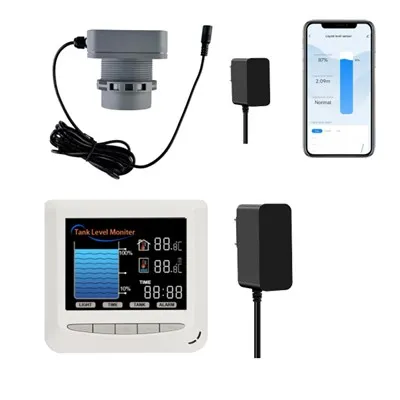
First, let’s recap how these sensors work, quick, so we’re on the same page. An ultrasonic level sensor sits on top of the tank (usually mounted on a flange or a bracket that bolts straight to the top rim), shoots a high-frequency sound wave down at the liquid or solid level inside, and times how long it takes for that sound to bounce back up to the sensor. The longer the delay, the farther away the surface is, so the lower the level. It’s super accurate—like within a quarter-inch—when everything’s working normally. But when the tank’s vibrating, that whole “time delay” math goes sideways, plain and simple.
Here’s the thing about tank vibration: it’s not just a little shake. Industrial tanks aren’t static objects. They’re connected to pumps, agitators, conveyor systems, even pipework that runs to other equipment. A 10,000-gallon water tank holding up to 20 feet of liquid? If the pump feeding it is running at 1,800 RPM, that creates a consistent vibration that transfers through the foundation, up the tank walls, and straight to the sensor mount. Some tanks vibrate so much you can see the top rim moving if you stare at it for 10 seconds. I once worked with a wastewater treatment plant that had a digester tank next to a large aeration blower—their sensor readings were jumping 3 feet up and down all day, and when we measured the vibration at the sensor mount, it was 0.8g at 60Hz. For context, that’s enough to make a small toy car bounce across a table.
So how does that vibration mess with the sensor’s performance, exactly? Let’s get into the nitty-gritty without losing you. The sensor’s transducer (the part that shoots and listens for the sound wave) is mounted rigidly to the tank. If the tank’s vibrating up and down, the transducer is moving up and down too, right? But the sensor’s time delay calculation assumes the transducer is perfectly stationary at the start of the sound wave. If the transducer is bouncing down 0.2 inches every time it shoots a pulse, that means the sound wave has a shorter distance to travel than it would if the transducer was sitting still. The sensor calculates that as a lower level, even if the actual liquid level hasn’t moved an inch. And if the vibration is random—like from a pump that’s slightly out of balance, or a conveyor that jolts every few seconds—the readings jump all over the place, no pattern to them at all. That’s when operators start calling us at 2 a.m. because their inventory numbers are wrong and they can’t order more material.
But wait, it’s not just vertical vibration. I’ve seen horizontal vibration cause just as many problems. If the tank is shaking side to side at 50Hz, the sound wave the sensor shoots isn’t perfectly straight down anymore. It’s angled a little, and when that sound wave hits the tank wall instead of the liquid surface, it bounces back to the transducer as a false echo. The sensor gets confused: is that echo from the liquid? Is that from the tank wall? It starts averaging all the random echoes, so the readings are way off—sometimes even showing there’s no liquid in the tank when it’s actually full, which is a nightmare for batch processes. We had a food manufacturer a couple years back that was getting false “empty tank” alerts on their syrup tank, and they almost shut down a whole production run because they thought they’d run out of product. Turns out the tank was mounted next to a filling line that was causing side-to-side horizontal vibration, throwing the sound waves off. That’s when I learned never to skip a site walkthrough when a client has a sensor issue—you can’t fix vibration problems over the phone.
Now, not all vibration is created equal. We’ve had tanks with mild, consistent vibration (like from a small recirculation pump) that only caused a tiny offset in readings, and tanks with violent, irregular vibration that made the sensor basically useless. The big factors here are vibration frequency and amplitude. Frequency is how fast the tank is shaking—measured in hertz, which is just times per second. Amplitude is how far it moves, usually in g-force (gravity units; 1g is the force of gravity pulling down on you right now). Sensors have specs for maximum vibration they can handle, but most cheap off-the-shelf sensors only handle up to 0.5g at 50Hz. If you go over that, you start seeing errors. Our premium sensors, by the way, are rated for up to 2g at 100Hz, which solves most standard tank vibration issues—we’ve had clients switch from cheaper sensors that failed within months to ours that have been running for 3 years straight on vibrating tanks with zero issues.
Another thing a lot of people don’t realize: the stuff inside the tank affects how vibration hits the sensor too. If a tank is empty, the walls are stiffer, so vibration transfers more directly to the mount. If it’s full of liquid, the liquid absorbs some of the vibration, so the top rim moves less. We tested this at our lab once: same tank, same vibration source. When it was empty, the sensor mount had 0.7g of vertical vibration. When we filled it halfway, that dropped to 0.4g. When it was full, it was 0.2g. That’s a huge difference! So a sensor that works great when the tank is full might go haywire when it’s empty, especially if the tank only operates at low levels sometimes. We adjusted our installation guide after that test to remind clients to test vibration at the lowest expected level, not just full, because that’s where the problem usually pops up.
Now, let’s talk about what you can do if your sensor is getting messed up by tank vibration, because no one wants to replace their whole sensor setup every time they install a tank next to a pump. First, don’t just mount the sensor directly to the tank flange, like everyone does. We recommend vibration-isolating mounts—little rubber or spring brackets that decouple the sensor from the tank’s movement, so the sensor stays almost perfectly still even if the tank is shaking. We supply these for all our sensors, and in our wastewater digester example I mentioned earlier, adding a $150 isolation mount fixed their 3-foot reading swing completely. That’s way cheaper than replacing a whole sensor system.
Second, you can adjust the sensor’s signal processing settings. Most modern ultrasonic sensors have echo filtering, where you can set a blanking distance (the area right below the sensor where it ignores echoes, so it doesn’t pick up noise from the tank wall or internal obstructions) and can tune how it averages echoes. If your tank is vibrating, you can widen the averaging window a little so it ignores the random, fast-moving echoes from vibration, and only locks onto the consistent echo from the actual liquid surface. A lot of operators don’t know these settings exist—they just plug the sensor in and walk away—so that’s a quick fix if you have basic programming skills.
Third, do a site assessment before you install a new sensor. That might sound like extra work, but it’s way better than troubleshooting later. Bring a vibration meter (most industrial technicians have these) and measure vibration at the sensor mount point at all expected liquid levels, plus around any nearby equipment that could cause vibration. If you’re dealing with super high vibration, we also offer custom mounting brackets that we design for specific tanks—we did that for a steel mill that had blast furnaces causing constant vibration in their water tanks, and the custom mount cut sensor errors by 90%. I always tell clients: measure first, buy later. It saves you so much headache.
Wait, I should address a common myth here: a lot of people think ultrasonic sensors only work on still surfaces, and if the liquid is churning or the tank is vibrating, you should switch to radar or some other technology. But that’s not true. Radar works, sure, but it’s way more expensive, and it doesn’t handle foam or steam as well as ultrasonic does. Our ultrasonic sensors are optimized to handle mild to moderate vibration, especially with the right mounts. I’ve seen tanks with agitators running at full speed, causing 1g of vibration, where our sensors are accurate within half an inch. The problem is not the technology—it’s matching the sensor to the tank’s vibration, not just picking the cheapest one off Amazon.
I’ve been in this game long enough to see clients make the same mistakes over and over. They install a cheap sensor, it doesn’t work on their vibrating tank, they blame ultrasonic sensors entirely, and switch to something way more costly. Nine times out of ten, it’s not the technology—it’s not accounting for tank vibration. Vibration is one of those “invisible” problems because you can’t see it with your naked eye most of the time, but it’s messing with every measurement the sensor makes. The good news is, it’s almost always fixable without a full system replacement.
Here’s the thing I always tell new clients: ultrasonic level sensors are not set-it-and-forget-it devices. You have to consider the environment they’re in, and vibration is one of the biggest environmental factors you’ll run into with tank applications. It’s not a flaw in the sensor design—it’s a real-world condition that we engineer around. Our team spends a lot of time testing sensors in vibration chambers to make sure they can handle real industrial conditions, so when a client calls us with a vibration problem, we don’t just say “buy a different sensor”—we troubleshoot, figure out if a mount, a setting tweak, or a custom bracket will fix it. That’s the stuff that keeps clients coming back, not just selling a product and moving on.

If you’re dealing with wonky level readings on a tank that’s vibrating—whether that’s a pump-induced hum, agitator shake, or something else entirely—hit us up for a consultation. We don’t do hard sell tactics; we’ll ask you a few simple questions: what’s your tank size, what’s inside it, how much vibration are you seeing, what’s your current sensor setup—and give you a honest, practical solution, not a upsell. No jargon, no hidden fees, just real advice from people who actually work with these sensors every day. Don’t let tank vibration mess up your operations—we’ve fixed this for hundreds of clients, and we can fix it for you.
Float Level Sensor References:
- Ultrasonic Level Sensor Application Guide. ISA (International Society of Automation), 2021.
- Vibration Effects on Ultrasonic Transducer Performance. Journal of Industrial Sensors and Instrumentation, Vol. 12, No. 3, 2019, pp. 45-52.
- Mounting Best Practices for Industrial Ultrasonic Level Sensors. Process Industry Practices (PIP) Guidelines, 2022.
- Field Evaluation of Ultrasonic Sensor Robustness to Mechanical Vibration. Control Engineering Magazine, May 2020, pp. 28-32.
Shenzhen Fineherc Technology Co., Ltd.
As one of the most experienced ultrasonic tank level sensor suppliers in China, we’re featured by quality products and low price. Please feel free to buy discount ultrasonic tank level sensor made in China here from our factory. Welcome to view our website for more information.
Address: 5th Floor, Building D, No. 39, Keji East Road, Torch Development Zone, Zhongshan City,China
E-mail: fineherc@hotmail.com
WebSite: https://www.fineherc.com/
